

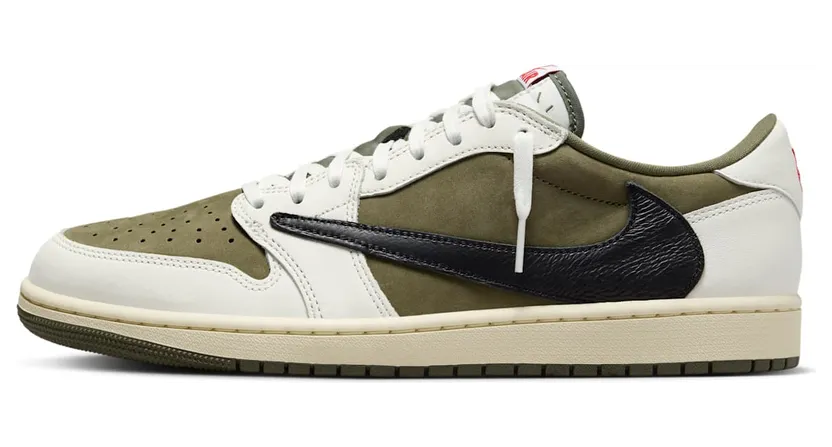
With popular releases, the interesting question is rarely whether the sneaker is any good. It usually is. The more interesting question is what you’re paying for it, and why that amount varies so wildly. Travis Scott’s Air Jordan 1 Low OG in “Medium Olive” (DM7866-200) is a neat example: a shoe that has been on the market since September 28, 2024, and has primarily been treated as a commodity ever since.
The shoe itself is cleaner than you might expect
Let’s be honest about what’s on the table. The “Medium Olive” is one of the more understated releases from this collaboration. Olive green in a matte, suede-like finish covers the toe box, side panel, and heel, surrounded by off-white leather overlays. The midsole has a cream tint that’s deliberately made to look slightly aged, while the outsole comes in the same olive shade, with a small red accent at the heel. Beyond that, it’s restrained. Officially called Medium Olive/Black/Sail/Muslin, those four words describe it exactly.
The signature feature of this series is, of course, still here: the reversed Swoosh, made from black leather with a pronounced grain, stretching across the entire side. Whether you still consider that a stroke of genius after all these pairs or think it has become a gimmick is up to you. As a silhouette, at least, it’s an Air Jordan 1 Low you can wear with a straight face under a pair of chinos, which is more than can be said for many hype sneakers.
Eighteen listings, a difference of more than six hundred euros
Now for the numbers, because that’s where things get really interesting. At the moment, our comparison shows eighteen active listings for stylecode DM7866-200. The cheapest is asking 547 euros, while the most expensive is listed at 1,166 euros. Same stylecode, same box, same label inside.
Seventeen of those eighteen listings come from marketplaces. There is exactly one regular retailer among them. That’s not a footnote; it’s the heart of the story: this isn’t a store offering with a sensible markup, but a resale market where the price mainly depends on who happens to have your size on the shelf. A difference of more than six hundred euros isn’t price discovery anymore. It’s noise.
What buyers are really worried about
More revealing than any price tag is what people search alongside it. After “release date,” the Dutch search suggestions almost immediately turn to legit check and real vs fake. There it is: a sneaker costing six hundred euros or more, and the buyer’s first instinct is to wonder whether their pair is even authentic. That’s not something you can blame the brand for, but it does say a lot about the market that has grown up around it.
The Hypescore measures energy, not whether you should buy
In our own data, this colorway has a Hypescore of 89, putting it in the ATOMIC tier — the highest level we use. And that checks out: the buzz is there, the demand is there, and the shoe still gives off plenty of energy. But the Hypescore measures how much hype energy a sneaker generates, not whether buying it is a sensible move. The two are mixed up surprisingly often, and rarely in a way that benefits your wallet.
What I would do
If you want it, buy it. It’s a good shoe, and it’s your money. But don’t go with the first tab you happen to open. With a spread like this, the difference between the bottom and top of the market is literally the price of a second pair. Compare the price for your size across all sellers, check whether your size is at the cheaper end, and only check out once you know what everyone else is asking. With Jordan releases of this caliber, that isn’t being stingy. It’s simply paying attention.