

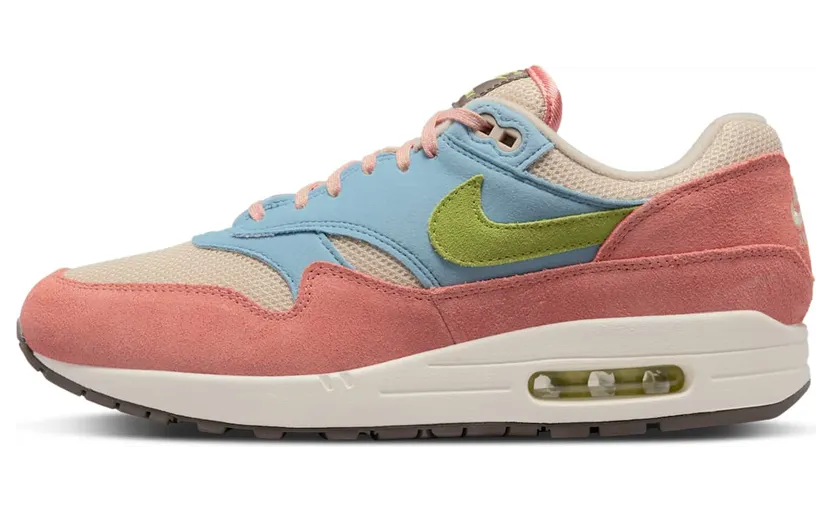
Some releases are all anyone can talk about, while other pairs quietly stay in your rotation because they just work. The Nike Air Max 1 “Light Madder Root / Worn Blue” (DV3196-800) falls into the second category for me. No collab, no queue, no drama. Just one of the best-colored Air Max 1s you can still easily find in your size.
What you see on the shoe
The construction is classic Air Max 1: mesh on the toe box and side panel, with suede overlays around them. What sets this pair apart is the color distribution. The toe box, mudguard, and heel panel are salmon-pink suede — that’s the “madder root.” The midpanel above it is a dusty light blue, also in suede, topped with an olive-green swoosh. The mesh is cream, the midsole is sail, the laces are pink, and the outsole is dark brown. The Air window in the heel has a greenish tint. Four colors on one shoe, and somehow it still doesn’t look like a circus.
Madder root isn’t just a marketing term someone came up with: it’s the root of the madder plant, which was used for centuries as a natural red dye. That slightly faded, earthy red-pink shade is exactly what you see here — it’s not bright pink, and that’s why this pair remains so wearable.
Why it remains interesting
Colorful Air Max 1s have one problem: they’re fun for a week after release, then sit untouched because you can’t pair them with anything. This one lands right on the edge. The pink is muted enough to work with denim, while the blue and green only appear in smaller sections. I like wearing it with something simple — cream, jeans, gray — and letting the shoe do the talking.
One practical note: suede on both the toe box and the mudguard means maintenance. Use a brush, apply protector spray before wearing them for the first time, and keep them out of the rain. You’ll notice wear on the lighter sections sooner than you’d like. That’s also the first thing to check when buying a used pair: the toe box and heel edge tell you within two seconds what the pair is really worth.
What the prices are doing
This is where things get interesting for buyers. We’re currently tracking this pair across twenty active listings, with the lowest sitting around 150 euros while the top end climbs above 390 euros. That’s not a measurement error. It’s the difference between shops still treating them as regular inventory and shops pricing them as a resale item. The upper half of that list also contains plenty of one-off size listings, and that’s exactly where the prices start to spread out.
My advice is boring, but it works: don’t look at the first price you see; look at the entire list. With a sneaker this spread out, the difference between buying well and buying badly can be almost twice the price. And check your size before going for the cheapest option — that advantage disappears fastest in the harder-to-find sizes.
Grail or simply a good buy?
This isn’t a grail, and it doesn’t need to be. In our data, the Light Madder Root has a Hypescore in the ATOMIC band, so there’s plenty of activity. But that demand is spread out over time rather than concentrated around a single drop, which is exactly why the listings vary so widely. For buyers, that’s good news: you don’t have to wait for anything; you just need to look a little more carefully than average.
Want a pair? Compare the Nike Air Max 1 in your size across all the shops we track, then scroll through the rest of Nike as well. With this kind of price spread, the difference is literally two clicks away.